Price isn't your problem: it's the brand that's missing
When the only reason to choose you is price, it means you haven't given them another one
by: Jacopo Mencacci
23 June 2026 — Reading time: 6'
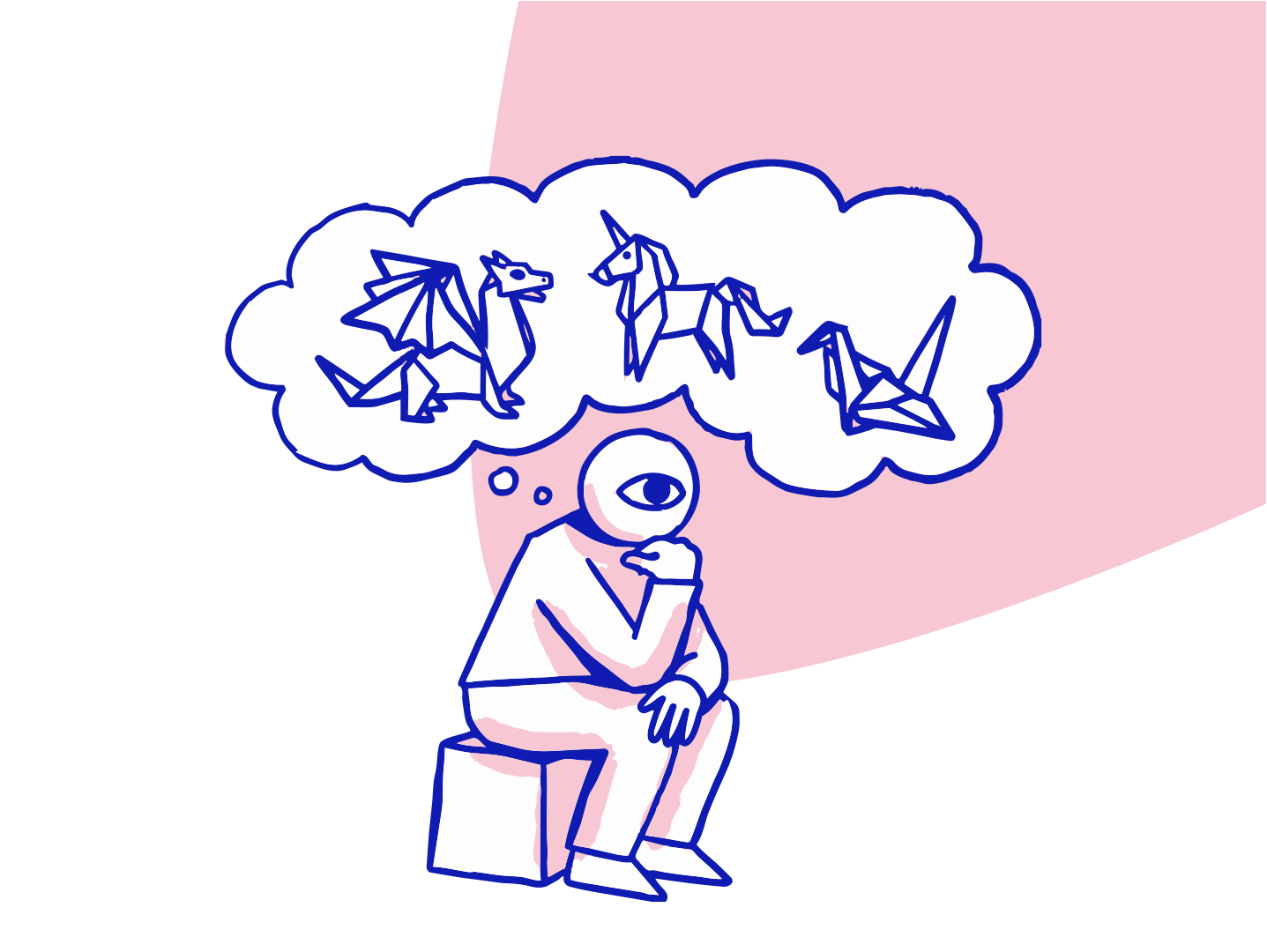
A few months ago, during a coffee break with the marketing manager of a food company, the director walked over and started venting. A competitor had begun aggressively undercutting the market, selling the same products for a few cents less per unit. “I don’t know how they do it,” he told us. “We’re already running on thin margins. I have no idea where to find those extra cents to keep up.”
He was someone who knew his product well, believed in it, and knew his was better. But in that moment, he was thinking as if the only game in town was the price game. As if his room to manoeuvre was limited to the gap between his production cost and his competitor’s. As if no other lever existed.
That conversation stayed with us, because it describes with precision a trap many companies fall into: a good product, a weak identity, and a market that consequently treats them as a commodity.
The price war is a perception problem, not a price problem
When a customer can’t distinguish between you and a competitor on the basis of value, price becomes the only available measure of judgement. Not because your product is the same as everyone else’s. It may even be better. But if that difference isn’t visible, tangible, felt, then for the buyer it simply doesn’t exist.
This is commodity territory: not a verdict on the product, but a failure of perception. And perception is either built deliberately, or left for others to build for you.
The practical consequence is real: every time you speak to a potential client, your sales team starts from scratch explaining who you are. Every negotiation becomes a battle over price. Every renewal is at risk because a competitor only needs to offer 5% less. Not because your product is worth less, but because nothing in the customer’s mind yet justifies the difference.
Brand: an asset that works even when you’re not in the room
Brand is not the logo. The logo is a symbol — important, but only the tip of the iceberg. Brand is the system of meaning a company builds in the minds of its customers over time: what you stand for, what you promise, why someone should choose you over anyone else. It’s what remains when you leave the room.
When that system works, three concrete things happen.
It enables choice
At the moment a customer is weighing their options, brand is what helps them distinguish you. You’re no longer selling technical features: you’re selling a promise already lodged in their mind, built over time through every touchpoint. Your sales rep doesn’t start from zero explaining who you are — they start from an already-formed perception, and work to confirm it.
It builds loyalty
A customer who chose you for reasons of value is far harder to poach with a discount. They’ve already solved the problem of choice: they know why they buy from you, and switching suppliers would require an effort they’re not willing to make to save 5%. Every satisfying purchase reinforces the perception; every confirmation of the promise makes the customer less sensitive to competitors’ offers.
It aligns the organisation internally
In SMEs with multiple partners or broad sales teams, one of the most silent forms of waste is message fragmentation: every person describes the company slightly differently, every department has its own idea of what the differentiating value is. A well-defined brand is the compass that aligns internal decisions and ensures the promise reaching the customer is always the same, regardless of who made the call.
There’s a final aspect that makes all of this even more concrete. Brand is not just a competitive tool: it’s a real, measurable economic value, directly reflected in how a company is valued. Interbrand calculates this every year for the world’s leading brands: in the 2024 ranking, Apple’s brand alone is worth $488.9 billion. Coca-Cola’s stands at $61.2 billion. These are numbers that factor into market valuations, acquisition negotiations, and balance sheets. Brand, in other words, is not only what makes people choose you — it’s also what determines what you’re worth.
What really happens when you build a brand (and what doesn’t)
The most common — and most mistaken — idea is that designing a logo equals building a brand. The logo is necessary: without a recognisable mark, everything else struggles to take hold in memory. But it isn’t sufficient. Brand is not a switch.
It’s an investment that takes time to settle in the public’s mind, requires coherence across every touchpoint, and depends on a promise that holds up under use. Value isn’t created by the designer: it’s created by the market, through repeated experiences that are consistent with the promise. The designer builds the conditions for that perception to form. It isn’t magic. It’s architecture.
There’s another distinction worth making, particularly for those who invest heavily in advertising. Investing only in ads without working on brand builds traffic at variable cost: every new customer requires the same investment as the last, and when you stop paying, the engine stops. Investing in brand builds value at decreasing cost over time, because reputation and trust accumulate. The two tools aren’t mutually exclusive — but without brand, marketing always works uphill.
How we work: from Brand Workshop to strategy to visual identity
In our projects, the brand identity process never starts with the logo. It starts with people: those inside the company and those outside it.
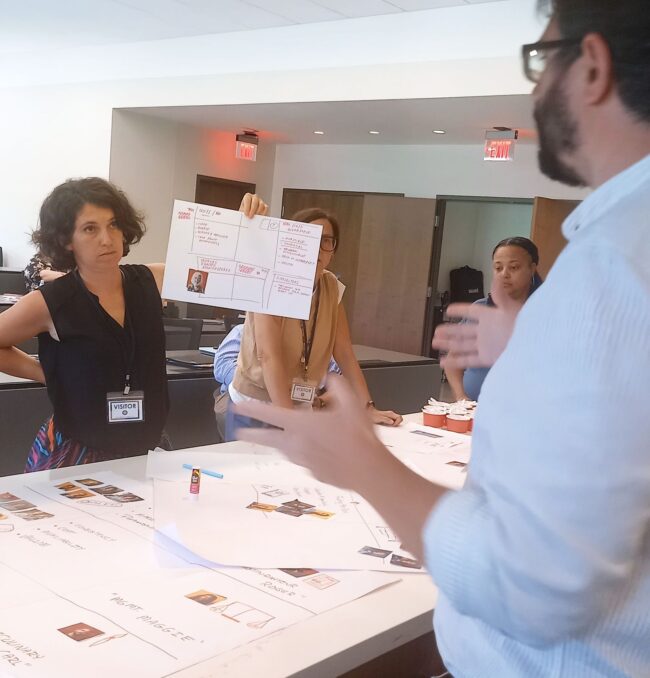
The tool we use is the Brand Workshop: a collaborative process that involves the company’s key figures — from CEO to sales team — using design thinking and gamestorming tools to surface positioning from within the organisation, rather than imposing it from above. The goal isn’t for the designer to decide who you are. It’s for you, supported by a facilitator, to arrive at that clarity yourselves.
The most significant example of this was the IGF project, a food service distributor based in North America. The Brand Workshop took place directly at the company’s American headquarters: three intensive days with the CEO, marketing, sales and procurement teams around the same table, conducted in English. What emerged wasn’t a list of product features. It was a vision of IGF as a community builder through food — a brand capable of creating authentic relationships throughout the supply chain. From that came a visual identity that made sense, because it had a strategy underneath.
An honest caveat: brand won’t save a mediocre product
Brand amplifies — it doesn’t create. If the product doesn’t live up to the promise, a strong identity doesn’t fix anything: it accelerates the fall, because the higher the expectation, the more painful the disappointment.
Our work isn’t to invent a story: it’s to find the true one and make it visible. If that story doesn’t yet exist, the problem is upstream, and no logo can solve it. The same applies to consistency over time: a project launched and then abandoned halfway, or an identity applied coherently on some touchpoints and ignored on others, does more damage than good — because it generates confusion instead of trust.
Qualitaly: a concrete case
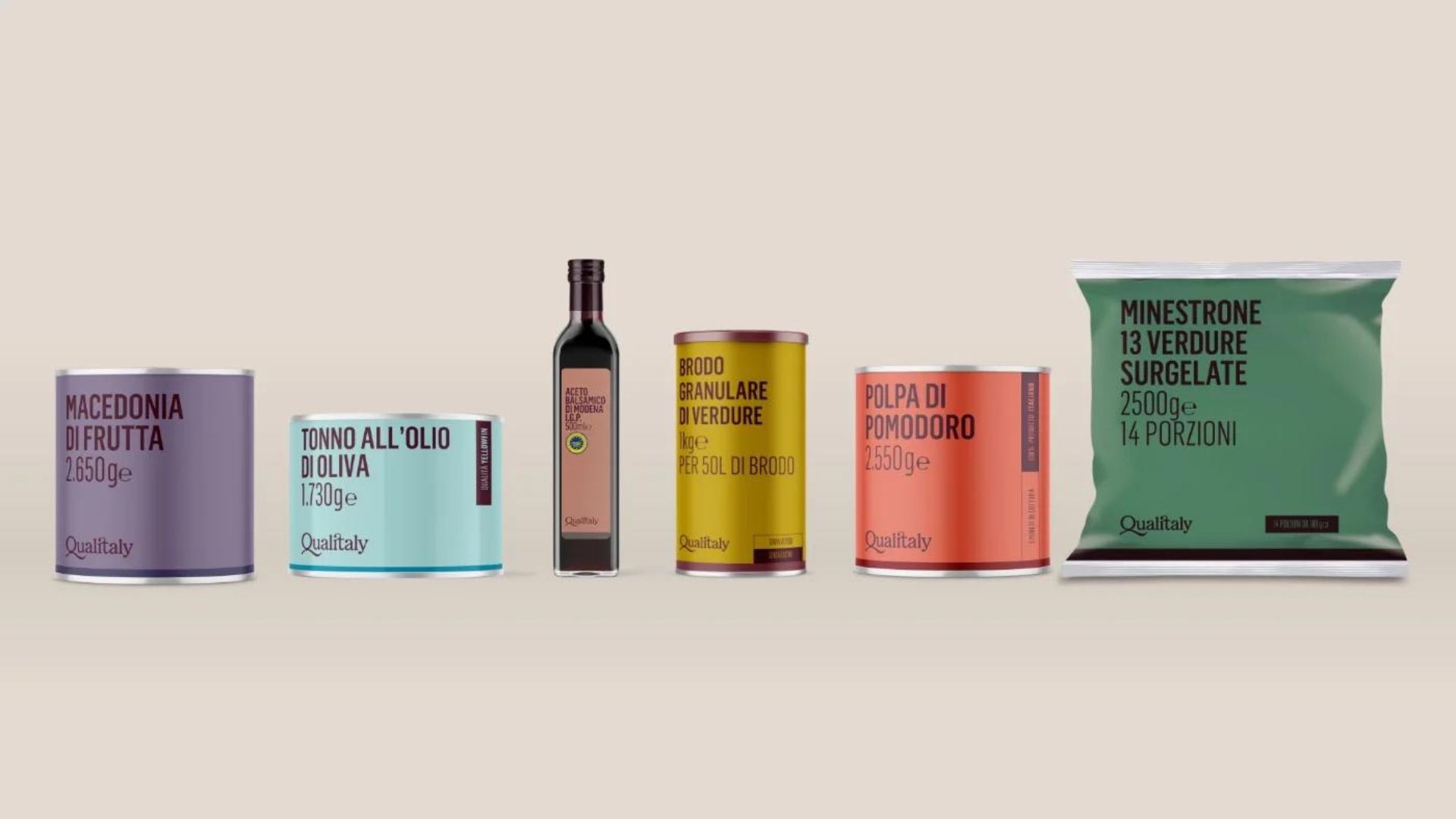
Cooperativa Italiana Catering had a mid-to-high quality product, over 700 references across multiple product lines, and a consolidated presence in the Ho.Re.Ca. sector. The problem was that all this value wasn’t coming through: the existing packaging couldn’t communicate it, and on the shelves of a professional warehouse every unit got lost among the others.
The project built a product identity system capable of adapting to hundreds of different references while maintaining coherence and recognisability — designed as a working tool: readable at a glance in a professional kitchen, practical for storage, clear in its information. The result won a special mention at the ADI Packaging Design Award 2023 and was selected for the Design Index 2023. In the year following the launch, Qualitaly’s turnover grew by 48%: the rebranding was one piece of a broader strategy, but an identity that clearly communicates value makes the sales team’s job easier and gives buyers a concrete reason to come back.
If your product is worth more than the market gives you credit for
That feeling that your product deserves more recognition, that its quality goes unseen, that the right customers aren’t finding you: it’s almost always well-founded. The problem is rarely the product. It’s the narrative surrounding it — or the absence of one.
If you’d like to understand where to start, book a discovery call: thirty minutes to look at your current situation together and understand whether and how brand work can make a difference for your business.